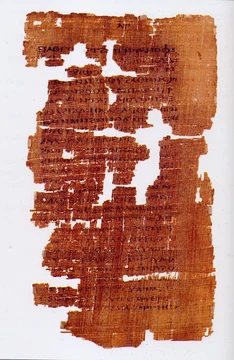
Gospel of John
Fourth gospel emphasizing Jesus as divine Logos and Son of God.

The Gospel of John is the fourth gospel of the canonical gospels in the New Testament. It presents a schematic account of the ministry of Jesus, with seven signs culminating in the raising of Lazarus, and portrays the final week of Jesus’s life, including the Farewell Discourse and the passion and resurrection narratives. Most scholars agree it was completed between 90–100 AD.
- Completed
- 90–100 AD
- Attributed author
- John the Apostle (traditionally); internally anonymous
- Genre
- Gospel (Greco-Roman biography)
- Key source
- Unnamed 'disciple whom Jesus loved'
- Part of
- Johannine literature (with Johannine epistles and Book of Revelation)
- Notable for
- Clearest identifications of Jesus with God in Christian texts; Jesus as Logos
Lore & Background
The gospel displays a literary unity throughout its text, and the current scholarly tendency is to approach the work as a coherent whole by a single author. It contains the clearest identifications of Jesus with the God of Israel in the Christian texts, with Jesus in the form of the Logos being paralleled in Greek philosophy and Targumic concepts of the divine. Although distinct from the Synoptic Gospels, most scholars today accept that John knew and used the Synoptics. John's relatively free usage of Mark aligns with the compositional practices of antiquity while contrasting with the unusually conservative adaptations found by the Synoptic authors.
Reader's Guide
The Gospel of John is significant for its unique portrayal of Jesus as the divine Logos, the Word made flesh, and for its clear identification of Jesus with God. Its structure is highly schematic, with seven 'signs' and seven 'I am' sayings, culminating in Thomas's proclamation of the risen Jesus as 'my Lord and my God.' The gospel's purpose, as stated in its penultimate chapter, is 'that you may continue to believe that Jesus is the Messiah, the Son of God, and that through believing you may have life in his name.' Its legacy includes shaping Christian theology on the divinity of Christ and influencing debates on authorship, community origins, and the relationship between the Johannine and Synoptic traditions. The gospel's historical context remains debated, and the paradigm of a Johannine community has been increasingly challenged in the 21st century.
Did You Know?
- The Gospel of John contains seven 'signs' that culminate in the raising of Lazarus.
- Most scholars agree the gospel was completed between 90–100 AD and likely composed in Ephesus.
- The gospel identifies an unnamed 'disciple whom Jesus loved' as its source and, perhaps, author.
- The concluding verse of chapter 20 states the gospel's purpose: 'that you may continue to believe that Jesus is the Messiah, the Son of God.'
Frequently Asked Questions
Who wrote the Gospel of John?
Tradition credits John the Apostle, but the text itself is anonymous and points only to an unnamed 'disciple whom Jesus loved' as its primary witness. Most scholars therefore treat it as the product of a broader Johannine community rather than a single identifiable author.
What sets the Gospel of John apart from the other three canonical gospels?
Instead of a chronological run of parables, John organizes the narrative around seven deliberate signs that build toward the raising of Lazarus. It also contains the most direct identifications of Jesus with God in the New Testament, opening with the figure of the divine Logos.
What are the seven signs in the Gospel of John?
The sequence runs from turning water to wine, healing the official's son, curing the paralytic at Bethesda, feeding the five thousand, walking on water, healing the man born blind, and finally raising Lazarus from the dead. John presents them as staged revelations of Jesus's divine identity, with the Lazarus miracle serving as the pivotal turning point that accelerates the plot toward the cross.
When was the Gospel of John completed?
Scholarly consensus places its final composition around 90 to 100 AD, making it the latest of the four canonical gospels. It belongs to the same literary family as the three Johannine epistles and the Book of Revelation, a group often called the Johannine corpus.
What does 'Logos' mean in the opening of the Gospel of John?
The Greek term Logos, meaning 'Word' or 'Reason,' is a concept familiar in Hellenistic philosophy, and John fuses it with the Hebrew idea of God's creative Word. By calling Jesus the pre-existent Logos through whom all things were made, the gospel asserts a level of divinity for him that goes well beyond the 'Son of God' titles found in the Synoptics.
More in Christian Scriptures And Epistles 1-18
Spotted an error? Know more?
This is a living reference — every entry is fact-audited, and reader corrections feed straight into our audit queue. Suggest an edit · See this site's audit record