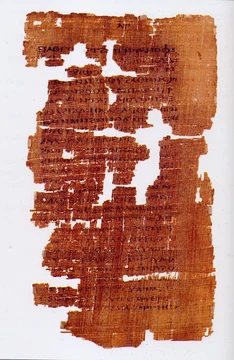
Epistle to the Ephesians
A New Testament letter urging unity and holiness in Christ.

The Epistle to the Ephesians is a Pauline epistle and the tenth book of the New Testament of the Christian Bible. It stands among the canonical writings that shaped early Christian identity and is traditionally grouped with the letters attributed to Paul the Apostle. The text is traditionally believed to have been written by Paul around AD 62 during his imprisonment in Rome, though many modern scholars dispute the attribution and date the work to AD 70–100 as a circular letter.
- Traditional Author
- Paul the Apostle
- Traditional Date
- c. AD 62
- Modern Scholarly Date Range
- AD 70–100
- Place of Traditional Composition
- Rome (during imprisonment)
- Biblical Book Number
- 10th book of the New Testament
- Key Theme
- Unity of all creation in Christ and holy conduct
Lore & Background
The Epistle to the Ephesians sets out a theological vision of God's plan to unite all creation in Christ and exhorts the church to embody that unity through reconciliation across ethnic boundaries and holy conduct in everyday relationships. According to New Testament scholar Daniel Wallace, the theme may be stated pragmatically as 'Christians, get along with each other! Maintain the unity practically which Christ has effected positionally by his death.' Another major theme is the keeping of Christ's body (the Church) pure and holy. The letter's authorship is debated. The first verse identifies Paul as its author, and early lists such as the Muratorian fragment attribute it to Paul. However, challenges to Pauline authorship exist on the basis of non-Pauline syntax, terminology, and eschatology. Bible scholar Raymond E. Brown asserts that about 80% of critical scholarship judges that Paul did not write Ephesians. The letter contains an outline that includes a greeting, a general account of blessings, a description of the change in spiritual position of Gentiles, a chapter on unity amid diversity, instructions about ordinary life, and imagery of spiritual warfare including the Armor of God. The founding of the church at Ephesus is recorded in Acts, with Paul's first visit of three months and a later stay of three years.
Reader's Guide
The Epistle to the Ephesians holds significance as a canonical writing that shaped early Christian identity, particularly through its emphasis on unity and holiness. Its theological vision of God's plan to unite all creation in Christ addresses the multicultural context of a church with Jewish and Hellenistic backgrounds. The letter's exhortations to reconcile across ethnic boundaries and maintain holy conduct in everyday relationships have influenced Christian ethics and ecclesiology. The authorship debate reflects broader scholarly questions about the development of early Christian literature. The traditional view of Pauline authorship is supported by some scholars, while others argue for pseudonymity or dictation with interpolations. This uncertainty does not diminish the letter's impact; it remains a key text for understanding early Christian theology and community formation. The letter's structure, including the metaphor of the Armor of God, has been influential in Christian spiritual teaching. Its purpose, as noted by C.H. Dodd, is regarded as the 'crown of Paulinism,' born out of its socio-historical context and addressing issues appropriate to diverse religious and cultural backgrounds.
Did You Know?
- The words 'in Ephesus' do not appear in the best and earliest manuscripts of the letter, leading some textual critics to regard them as a later interpolation.
- The letter closely resembles the Epistle to the Colossians and is thought to have been addressed to the church in Ephesus (now in Turkey).
The Authorship Question
The identity of Ephesians' author remains one of the most contested questions in New Testament scholarship. The letter's opening verse names Paul, and early canonical lists—including the Muratorian fragment and possibly Marcion's canon, where it may appear under the title 'Epistle to the Laodiceans'—attribute it to the apostle. Yet critical scholars have long pointed to syntax, vocabulary, and eschatological outlook that strike them as distinctly non-Pauline. Raymond E. Brown estimated that roughly 80 percent of critical scholarship sides against Paul. Four broad positions now structure the debate: full Pauline authorship, Pauline dictation with later interpolations, outright non-Pauline composition, and the view that the evidence remains inconclusive.
Theological Vision and Ethical Exhortation
At its heart, Ephesians articulates a sweeping theological vision: God's redemptive plan aims to unite all of creation in Christ. From this cosmic purpose flows a practical imperative for the church. The letter exhorts believers to embody that unity by crossing ethnic divides and by living holy, reconciled lives within everyday relationships. New Testament scholar Daniel Wallace captures the letter's practical thrust with a blunt summary: Christians are called to get along with one another, maintaining in daily conduct the unity that Christ has already secured through his death. A second major thread runs through the text—the preservation of the Church as Christ's body, kept pure and holy. The letter's second half, spanning chapters four through six, shifts from doctrinal exposition to concrete moral instruction, offering guidance on how to live a Christ-inspired, ethically disciplined life. The movement from grand cosmic theology to household-level ethics gives the epistle its distinctive shape.
The 'In Ephesus' Problem and the Circular Letter Hypothesis
One of the letter's most intriguing textual puzzles concerns its addressee. Most English translations open with a greeting to 'the saints who are in Ephesus,' yet the phrase 'in Ephesus' is absent from the best and earliest manuscripts. This lacuna likely explains why the earliest known New Testament corpus identified the letter as the Epistle to the Laodiceans. Compounding the mystery, the author never greets any individual by name and never references a specific local circumstance—behavior that sits awkwardly alongside the Book of Acts' account of Paul spending more than two years in Ephesus. Textual critic Bart Ehrman regards 'in Ephesus' as a later scribal insertion. The prevailing scholarly view, however, is that the letter functions as a circular document intended for multiple congregations. The Jerusalem Bible notes that some critics propose the original text left a blank after 'who are' for the recipient community to fill in its own name. This reading transforms Ephesians from a local pastoral letter into a broad ecclesial communication.
Dating, Setting, and Early Reception
The traditional dating places Ephesians in Rome around AD 62, composed during Paul's first imprisonment and not long after his arrival there—roughly four years after he bid farewell to the Ephesian elders at Miletus. The letter's close resemblance to Colossians and its thematic kinship with Philemon reinforce this cluster of so-called prison epistles. Scholars who reject Pauline authorship, however, push the date into the 70s or 80s CE, and some extend the range as late as AD 100, proposing that the work may have originated within the Ephesian church itself. The earliest identifiable reader of the text appears to be Ignatius of Antioch in the second century, whose own writings parallel many of Ephesians' ideas with evident familiarity. As the tenth book of the New Testament, the epistle has long stood among the canonical writings that shaped early Christian identity, and its placement within the Pauline corpus—regardless of whether its author was the apostle himself—testifies to the early church's conviction that its theology and ethics spoke with apostolic authority.
Frequently Asked Questions
Who is Epistle to the Ephesians?
The Epistle to the Ephesians is the tenth book of the New Testament and a Pauline letter traditionally attributed to Paul the Apostle. It is a canonical text that has shaped early Christian identity and is grouped with the other letters ascribed to Paul.
What are Epistle to the Ephesians's powers/role?
Its central role is to urge the unity of all creation in Christ and to call believers toward holy conduct. It functions as a theological and practical guide, weaving together cosmic scope with everyday instructions for family life and spiritual vigilance.
How does Epistle to the Ephesians's story end?
The letter closes with a series of practical exhortations covering household relationships, spiritual armor, and mutual encouragement, followed by a final benediction of grace. There is no narrative plot; the 'ending' is a doxology praising God through the church.
Why is Epistle to the Ephesians important?
It is one of the foundational canonical writings that defined how early Christians understood their identity as a unified body of Jew and Gentile in Christ. Its themes of divine grace, the church as Christ's body, and holy living continue to anchor Christian theology and practice.
When and where was Epistle to the Ephesians written?
Tradition places its composition in Rome around AD 62, while Paul was under house arrest. Many modern scholars, however, argue for a later date between AD 70 and 100 and suggest it was originally a circular letter sent to multiple churches rather than a single congregation.
More in Christian Scriptures And Epistles 1-18
Spotted an error? Know more?
This is a living reference — every entry is fact-audited, and reader corrections feed straight into our audit queue. Suggest an edit · See this site's audit record