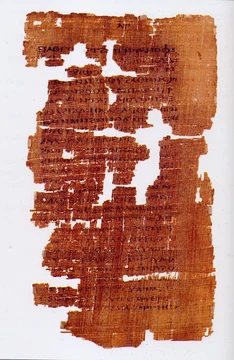
Epistle to the Colossians
A New Testament letter proclaiming Christ's supremacy over creation.

The Epistle to the Colossians is a Pauline epistle and the twelfth book of the New Testament of the Christian Bible. It was written, according to the text, by Paul the Apostle and Timothy, and addressed to the church in Colossae, a small Phrygian city near Laodicea and approximately 100 miles from Ephesus in Asia Minor. Many scholars question Paul's authorship and attribute the letter to an early follower instead, but others still defend it as authentic.
- Authorship
- Attributed to Paul and Timothy; disputed by scholars
- Date of composition
- c. 60s AD if by Paul; possibly late 1st century if pseudonymous
- Original language
- Koine Greek
- Location of writing
- Possibly Rome, Caesarea, or Ephesus (if by Paul)
- Addressees
- Church in Colossae, Asia Minor
- Category
- Prison epistle (if by Paul)
Lore & Background
The Epistle to the Colossians was written during the first generation after Jesus, helping to establish early Christian theology. According to Bruce Metzger, it was written in the 60s while Paul was in prison. Other scholars have ascribed the epistle to an early follower of Paul, writing as Paul due to its similarity with other contested works. The epistle's description of Christ as pre-eminent over creation marks it, for some scholars, as representing an advanced christology not present during Paul's lifetime. Defenders of Pauline authorship cite the work's similarities to the letter to Philemon, which is broadly accepted as authentic.
Reader's Guide
The Epistle to the Colossians is significant for its high Christology, proclaiming Christ as supreme over all creation and the head of the church. It warns against false teachers who promoted a human philosophy and cosmic powers, urging believers to live godly lives. Critics note 48 words found nowhere else in Paul's writings and a strong liturgical-hymnic style, while defenders argue that differences can be explained by human variability, use of secretaries, and growth in theological knowledge. The letter's legacy includes its influence on early Christian theology and its inclusion in the New Testament canon, with surviving manuscripts such as Papyrus 46 (c.
Did You Know?
- The epistle contains 48 words found nowhere else in Paul's writings and 33 that occur nowhere else in the New Testament.
- Colossians is often categorized as one of the 'prison epistles,' along with Ephesians, Philippians, and Philemon.
- The oldest surviving manuscript of Colossians is Papyrus 46, dating to around AD 200.
- The letter mentions local brethren in Colossae, Laodicea, and Hierapolis, cities in the same region as the seven churches of Revelation.
The Authorship Question
The question of who actually penned the Epistle to the Colossians remains one of the most actively debated issues in New Testament scholarship. The letter itself names Paul the Apostle and Timothy as its authors, and this attribution was accepted without serious challenge by prominent early theologians including Irenaeus, Clement of Alexandria, Tertullian, Origen, and Eusebius. It was not until the nineteenth century that critical scholars began to raise formal doubts. Skeptics point to 48 vocabulary items absent from Paul's other letters (33 of them unique to the entire New Testament), a pronounced liturgical-hymnic register, and Christological themes that seem to exceed what appears in the undisputed epistles. Defenders counter that theological growth over time, different writing occasions, and the use of various secretaries can account for stylistic variation, noting that Galatians contains a comparable number of rare words. Karl Barth, while acknowledging the legitimate questions, ultimately argued that the content mattered far more than the identity of the scribe.
Dating, Location, and the Prison Epistles
Scholars generally place the composition of Colossians within the first generation after Jesus, during a period when Paul's letters to various congregations were shaping the contours of early Christian theology. Bruce Metzger dates the letter to the 60s AD, likely composed while its author was in imprisonment. If Paul is the writer, the most commonly proposed setting is Rome during his first incarceration, with a specific date of 62 AD tied to the Roman imprisonment following his voyage there. The letter is traditionally grouped among the prison epistles alongside Ephesians, Philippians, and Philemon, and all three of these letters appear to have been dispatched together by the courier Tychicus accompanied by Onesimus. Some scholars, however, have suggested alternative locations such as Caesarea or Ephesus. The text itself hints at the use of an amanuensis, a professional secretary, as indicated in chapter 4, verse 18, with Timothy being a plausible candidate. The original was composed in Koine Greek. If the letter is instead the work of a later follower writing under Paul's name, its date could shift to the late first century, potentially as late as AD 90.
Surviving Manuscripts and the Textual Chain
The original manuscript of the Epistle to the Colossians has not survived, and many early copies are likewise lost. What remains is a chain of later transcriptions, each with its own textual variations. The earliest surviving witness to any portion of this letter is Papyrus 46, dating to approximately AD 200, making it a remarkably close copy to the original composition. Because no single manuscript contains the complete letter in its earliest form, and because the surviving copies show variation among themselves, reconstructing the precise wording of the original remains an ongoing task for textual critics. The gap between the likely date of composition in the 60s AD and the earliest papyrus from around AD 200 represents a significant window in which the text was transmitted in now-lost written copies.
A Small Phrygian Town and Its Theological Challenges
The Epistle to the Colossians is addressed to a small Phrygian city situated in Asia Minor, roughly 100 miles from Ephesus. Colossae sat in close proximity to two neighboring communities: Laodicea, about 12 miles away, and Hierapolis, approximately 14 miles distant. All three towns appear in the letter as sites of local Christian brethren, and the region overlaps with the area of the seven churches addressed in the Book of Revelation. The theological content of the letter is marked by its declaration of Christ as pre-eminent over all of creation, a christological claim that some scholars regard as representing an advanced stage of development beyond what is found in Paul's undisputed writings. The text also contains references to the elements and includes the only occurrence of the word philosophy anywhere in the New Testament. Based on these references, scholar Norman DeWitt has argued that the early Christian community at Colossae was likely influenced by Epicurean philosophy, a school of thought that taught atomism. This local philosophical environment appears to have shaped the particular concerns and arguments the letter addresses, making it a window into the intersection of Hellenistic thought and emerging Christian identity in a small Anatolian town.
Frequently Asked Questions
Who is Epistle to the Colossians?
It is the twelfth book of the New Testament, a letter directed at the early Christian community gathered in the small Phrygian town of Colossae. Within the Pauline corpus it is classified as a prison epistle, meaning the sender composed it while under confinement.
What is Epistle to the Colossians's role or purpose?
Its central theological thrust is declaring that Christ holds absolute supremacy over all of creation and that believers are already made complete in him. It also warns the Colossian assembly against false philosophical teachings that tried to supplement the gospel with extra rituals and speculations.
Who wrote Epistle to the Colossians?
The text names Paul the Apostle and Timothy as its authors, yet a significant number of modern scholars attribute it to a later follower writing in Paul's name. If genuinely Pauline it would date to the 60s AD; if pseudonymous it most likely belongs to the late first century.
Why is Epistle to the Colossians important?
It preserves one of the most concentrated Christological hymns in the New Testament, especially the passage portraying Christ as the agent and sustainer of all creation. It also stands as a key document for understanding how early Christians combated syncretistic philosophies that threatened the sufficiency of the gospel.
Where was Epistle to the Colossians written and who received it?
The recipient is the assembly of believers in Colossae, a modest city in Asia Minor situated near Laodicea and roughly a hundred miles from Ephesus. The place of composition remains uncertain, with Rome, Caesarea, and Ephesus all proposed depending on which authorship theory one accepts.
More in Christian Scriptures And Epistles 1-18
Spotted an error? Know more?
This is a living reference — every entry is fact-audited, and reader corrections feed straight into our audit queue. Suggest an edit · See this site's audit record