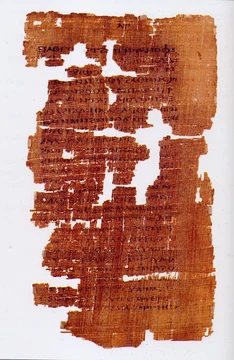
Epistle to Philemon
A Pauline prison letter urging reconciliation with a runaway slave.

The Epistle to Philemon is a Pauline epistle of the New Testament, widely regarded as one of the undisputed works of Paul the Apostle. It is the shortest of Paul's extant letters, consisting of only 335 words in the Greek text. The letter is a prison letter, authored by Paul (with Timothy mentioned in the opening verse) to Philemon, a leader in the Colossian church, and addresses themes of reconciliation, forgiveness, and Christian fellowship.
- field
- New Testament epistle
- author
- Paul the Apostle (with Timothy mentioned)
- recipient
- Philemon, Apphia, Archippus, and the church in Philemon's house
- length
- 335 words in the Greek text
- composition_date
- circa AD 57–62
- composition_location
- Caesarea Maritima or Rome (uncertain)
- known_for
- Shortest Pauline epistle; appeal for runaway slave Onesimus
Lore & Background
The Epistle to Philemon was composed around AD 57–62 while Paul was in prison, either at Caesarea Maritima or Rome. Scholars who do not dispute Pauline authorship of Colossians often hold that both were composed together. The letter is addressed to Philemon, a wealthy Christian and possibly a bishop of the church that met in his home in Colossae, along with Apphia (likely Philemon's wife) and Archippus (possibly their son). Paul does not identify himself as an apostle with authority, but as 'a prisoner of Jesus Christ,' calling Timothy 'our brother' and addressing Philemon as 'fellow labourer' and 'brother.'
Reader's Guide
The Epistle to Philemon is significant for its treatment of slavery and Christian fellowship within the Roman social context. While it does not explicitly condemn slavery, it reframes master-servant relationships in spiritual terms, asking Philemon to receive Onesimus not as a slave but as a 'brother beloved.' The letter emphasizes reconciliation and forgiveness, and its preservation suggests Paul's request was granted. The letter's authenticity has rarely been questioned by scholars, though a minority in the nineteenth century, led by Ferdinand Christian Baur, doubted it; this view is now considered outdated. The letter also raises questions about Onesimus' status, with some modern scholars challenging the traditional fugitive slave interpretation, though most evidence supports it.
Did You Know?
- The Epistle to Philemon is the shortest of Paul's extant letters, with only 335 words in the Greek text.
- Paul wrote the letter while in prison, either at Caesarea Maritima or Rome, around AD 57–62.
- Onesimus, the slave on whose behalf Paul wrote, is also mentioned in the Epistle to the Colossians as 'a faithful and beloved brother.'
- The letter does not explicitly condemn slavery but reframes master-servant relationships in spiritual terms.
The Heart of the Appeal
Paul chose an unusual strategy for a letter that could easily have been a command. Rather than invoking apostolic authority, he presented himself not as a figure of institutional power but as a prisoner of Jesus Christ, and he addressed Philemon with the warm, egalitarian titles of fellow labourer and brother. Timothy appears in the salutation not as a co-author but as a shared connection, likely someone Philemon knew from Paul's earlier ministry in Ephesus. The emotional core of the letter is Paul's plea for Onesimus, a man Paul calls his own son, whom he begot in chains. Paul offers to personally cover any debt Onesimus might owe, and he stresses that he is asking, not ordering—he wants Philemon's willing consent. The goal is not merely the return of a worker but the restoration of two men as beloved brothers in Christ, a transformation Paul suggests may have been part of a divine plan all along.
Authorship and the Question of Authenticity
Among Paul's surviving letters, the Epistle to Philemon holds a rare distinction: it is one of the seven undisputed epistles whose Pauline origin modern scholars accept without significant reservation. At merely 335 words in its Greek original, it is the briefest of all Paul's extant letters. The composition is generally dated to somewhere between AD 57 and 62, with Paul writing either from a prison in Caesarea Maritima or from Rome, and many scholars who accept Paul's authorship of Colossians see the two letters as a paired composition. The most notable challenge to its authenticity came in the nineteenth century from the Tübingen School, whose leader Ferdinand Christian Baur dismissed the letter's subject matter as suspiciously singular, suggesting it might be a Christian romance designed to convey a theological idea. That view has since been abandoned, and no mainstream scholarship today questions Paul's hand in the text.
Who Was Onesimus? The Interpretive Debate
The traditional reading presents Onesimus as a runaway slave who fled from his master Philemon, possibly after stealing money, and who subsequently encountered Paul, became a Christian, and was sent back with the letter. Yet this interpretation has not gone unchallenged. Allen Dwight Callahan, writing in the Harvard Theological Review, argued that nothing in the text conclusively establishes Onesimus as Philemon's chattel, and he traced the fugitive-slave reading back to John Chrysostom in the late fourth century, noting that earlier commentators like Origen were silent on the point. Callahan proposed instead that Onesimus and Philemon were estranged brothers seeking reconciliation. Ben Witherington III pushed back, calling this a misreading of Paul's rhetoric, while Margaret M. Mitchell demonstrated that writers well before Chrysostom—Athanasius, Basil of Caesarea, and Ambrosiaster—already assumed the slave reading. Most commentators still find the textual evidence, particularly Paul's insistence on consent and his plea to receive Onesimus no longer as a slave, consistent with the traditional view.
Reframing Power in a Slaveholding World
The letter operates within the rigid social hierarchy of first-century Roman society, where a slave's flight was a criminal offense and the owner held legal, financial, and social authority over the fugitive. Paul does not issue a blanket condemnation of the institution of slavery, yet the epistle performs a quiet but radical reorientation of the master-servant relationship. By insisting that Philemon receive Onesimus as a beloved brother rather than a piece of property, and by framing the entire encounter as a divine purpose that led to faith, Paul injects a spiritual equality that undermines the social order without directly attacking it. The letter's emphasis on reconciliation, forgiveness, and mutual fellowship within the Christian community offered an alternative ethical framework. The very existence of the letter in the canon hints that Philemon ultimately acceded to Paul's appeal, embracing a relational reality in which the bonds of the gospel could reshape even the most entrenched social categories of the Roman world.
Frequently Asked Questions
What is the Epistle to Philemon?
It is a brief personal letter from the Apostle Paul to a man named Philemon, dealing with the return of a fugitive slave named Onesimus. It is one of the shortest books in the New Testament at just 335 Greek words.
Who wrote the Epistle to Philemon?
Paul the Apostle is the author, with Timothy mentioned as a co-sender in the opening greeting. It is classified as a 'prison letter,' suggesting Paul composed it while under house arrest, likely in Caesarea or Rome around AD 57–62.
What is the main story of the Epistle to Philemon?
Paul pleads with Philemon to accept back his runaway slave Onesimus, whom Paul met and converted to faith while in chains. Rather than demanding legal rights, Paul appeals to Philemon's love and asks him to receive Onesimus as a brother in Christ.
Why is the Epistle to Philemon important in the canon?
It is one of the few undisputed Pauline letters and offers a rare glimpse into early Christian household dynamics and the treatment of slaves within the faith. Its themes of forgiveness, reconciliation, and mutual obligation shaped early church ethics on social relationships.
Who else is addressed in the Epistle to Philemon?
Besides Philemon himself, the letter is directed to Apphia, Archippus, and the congregation that meets in Philemon's home. This makes it one of the few New Testament letters written to a small domestic church rather than a whole city.
More in Christian Scriptures And Epistles 1-18
Spotted an error? Know more?
This is a living reference — every entry is fact-audited, and reader corrections feed straight into our audit queue. Suggest an edit · See this site's audit record