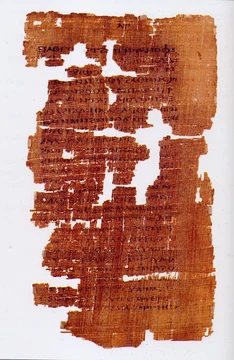
Epistle to Titus
One of three pastoral epistles, addressed to Saint Titus.

The Epistle to Titus is one of the three pastoral epistles in the New Testament, historically attributed to Paul the Apostle. It is addressed to Saint Titus and describes the requirements and duties of presbyters/bishops. The epistle is divided into three chapters, totaling 46 verses.
- field
- New Testament epistle
- attributed_to
- Paul the Apostle (disputed)
- addressed_to
- Saint Titus
- chapters
- 3
- verses
- 46
- classification
- Pastoral epistle
Lore & Background
Saint Titus is not mentioned in the Acts of the Apostles, but is noted in Galatians, where Paul wrote of journeying to Jerusalem with Barnabas, accompanied by Titus. He was later dispatched to Corinth, Greece, where he successfully reconciled the Christian community there with Paul. Titus was later left on the island of Crete to help organize the church, and later met back with Paul in Nicopolis. He soon went to Dalmatia (now Croatia). According to Eusebius of Caesarea, he served as the first bishop of Crete.
Reader's Guide
The Epistle to Titus is significant as part of the pastoral epistles, which provide instructions for church leadership and organization. Its authenticity has been debated: some scholars accept Pauline authorship, possibly via an amanuensis, while others regard it as pseudepigraphical, written after Paul's death. Critics point to vocabulary and style differences from the undisputed Pauline letters, and the epistle's close affinity with 1 Timothy suggests a common author, sometimes called 'the Pastor'. The epistle also contains a reference to the Epimenides paradox: 'Cretans are always liars.' The Church of England's Common Worship Lectionary Scripture Commentary views it as coming from the post-Pauline church world of the late first or early second century. The gnostic writer Basilides rejected the epistle. Its legacy lies in its influence on church structure and its role in debates over New Testament authorship.
Did You Know?
- The epistle is divided into three chapters, 46 verses in total.
- Saint Titus is not mentioned in the Acts of the Apostles.
- The epistle contains the Epimenides paradox: 'Cretans are always liars.'
- The gnostic writer Basilides rejected the epistle.
Titus and His Role in the Early Church
Saint Titus, the addressee of this letter, occupies a fascinating position in New Testament history. Unlike many of Paul's companions, he never appears in the Acts of the Apostles. His first biblical mention comes in Galatians, where Paul recounts traveling to Jerusalem alongside Barnabas with Titus in tow. From there, his trajectory reveals a man trusted with delicate diplomatic work: Paul sent him to Corinth, where he successfully mediated a reconciliation between the apostle and the Christian community Paul had founded. Later, Titus was stationed on the island of Crete to help organize the fledgling church there, a role that Eusebius of Caesarea, writing in his Ecclesiastical History, identifies as making him the island's first bishop. After reuniting with Paul in Nicopolis, Titus headed to Dalmatia, a region in what is now Croatia. His career thus spans multiple Mediterranean communities, and the very letter addressed to him outlines the requirements and duties expected of presbyters or bishops, suggesting he was being prepared for ongoing ecclesiastical leadership.
The Authenticity Debate
The question of who actually penned the Epistle to Titus has generated considerable scholarly disagreement. On the surface, as scholar Clare Drury observed, the claim that Paul wrote it appears almost self-evident: the letter opens with an apostolic greeting and includes personal asides that feel intimate. Yet Drury immediately cautions that the matter is far from settled, noting that markers pointing to a later date multiply throughout the text. A significant body of scholarship treats Titus, alongside 1 and 2 Timothy, as pseudepigraphical—composed by an anonymous writer after Paul's death. These critics point to vocabulary and stylistic features that, in their view, are inconsistent with what is known of Paul's biographical context, arguing instead that the language reflects the concerns of a maturing church. Most who hold this position date the composition between roughly 80 and 100 AD, though some push it as late as the end of the second century. The Church of England's Common Worship Lectionary Scripture Commentary echoes this assessment, seeing in the letter's balance of theological and practical themes the fingerprint of a post-Pauline ecclesial world.
Structure, Content, and the Epimenides Paradox
The Epistle to Titus is a compact work, organized into three chapters comprising a total of 46 verses. As one of the three pastoral epistles in the New Testament, its central concern is practical: it lays out the requirements and duties expected of presbyters and bishops within the early Christian community. This ecclesiastical focus distinguishes it from many of Paul's other letters and situates it firmly within the world of organized church governance. Beyond its administrative instructions, the letter contains one of its most striking and unusual features—a reference that has captured the attention of both theologians and logicians. In the course of his argument, the author quotes a Cretan prophet: 'Cretans are always liars.' This is the so-called Epimenides paradox, a self-referential statement that has become a touchstone in discussions of logic and truth. The inclusion of this local proverb, drawn from Cretan culture, gives the letter a distinctive secular flavor and grounds its theological instructions in the specific cultural setting of the island where Titus was serving.
The 'Pastor' and Scholarly Reception
A persistent thread in the study of Titus is its close literary relationship with 1 Timothy. The two letters share numerous phrases, expressions, and subject matter to such a degree that many scholars conclude they come from the same hand. This anonymous author is sometimes designated simply as 'the Pastor,' a label that captures the pastoral, church-governing character of all three letters. The gnostic writer Basilides, notably, rejected the epistle entirely, an early instance of the text being questioned outside mainstream Christian circles. In more recent decades, however, some scholars have attempted to rehabilitate Pauline authorship by proposing that Paul employed an amanuensis—a secretary to take dictation. This practice was well established in ancient letter writing, and Paul himself references such a practice in Romans 16:22. A more speculative suggestion even names Luke as a possible scribe for the pastoral letters. Whether one sides with the traditional Pauline attribution or the pseudepigraphical reading, the epistle's enduring influence on how early churches structured their leadership remains unmistakable.
Frequently Asked Questions
What is the Epistle to Titus?
It is a brief three-chapter letter (46 verses) found in the New Testament, classified as one of the three pastoral epistles. The letter is directed to a man named Titus and deals with organizing a local Christian community.
What is the main purpose or role of the Epistle to Titus?
The letter sets out practical expectations for how a church should be structured, specifically detailing the character and duties of presbyters (elders) and bishops. It also urges the community to live in a way that reflects good conduct and sound doctrine.
How does the Epistle to Titus conclude?
The final chapter wraps up with Paul sending personal greetings from several companions and instructing Titus to make a trip to Nicopolis. The letter closes with a brief benediction.
Why is the Epistle to Titus considered important in Christian tradition?
It is one of the very few New Testament documents that explicitly spells out qualifications for church leadership and governance, making it a key text for discussions on ecclesiastical order. As part of the pastoral epistle group, it also offers a window into early Christian community life in the Greek-speaking world.
Who is credited as the author of the Epistle to Titus?
The letter is traditionally attributed to Paul the Apostle, who writes in his own name throughout. However, a number of modern scholars question whether Paul actually penned it, noting stylistic and theological differences from his undisputed letters.
More in Christian Scriptures And Epistles 1-18
Spotted an error? Know more?
This is a living reference — every entry is fact-audited, and reader corrections feed straight into our audit queue. Suggest an edit · See this site's audit record