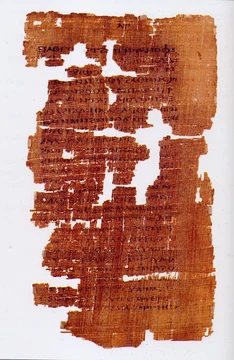
First Epistle of Peter
A contested New Testament letter addressing persecuted Christian exiles.

The First Epistle of Peter is a book of the New Testament. The author presents himself as Peter the Apostle, and the letter is addressed to the 'chosen pilgrims of the diaspora' in Asia Minor suffering religious persecution. Although both the text and tradition identify Peter as its author, most scholars conclude that the epistle is an expression of the Christian tradition at Rome associated with Peter rather than the apostle himself.
- field
- New Testament epistle
- known_for
- Addressing persecuted Christians in Asia Minor; discussing the Harrowing of Hell; instructions for wives and husbands
- authorship_debate
- Attributed to Peter but contested by most scholars
Lore & Background
The First Epistle of Peter is a book of the New Testament. The author presents himself as Peter the Apostle. The ending of the letter includes a statement that implies that it was written from 'Babylon', which may be a reference to Rome. The letter is addressed to the 'chosen pilgrims of the diaspora' in Asia Minor suffering religious persecution. Scholars debate whether its persecution refers to social discrimination or official Roman oppression. The letter also discusses the 'Harrowing of Hell' and instructions for wives to submit to their husbands, alongside exhortations for husbands to treat their wives with respect.
Reader's Guide
The First Epistle of Peter is significant as a New Testament text that addresses early Christian communities facing persecution. Its authorship is heavily contested: while the text identifies Peter as the author, most scholars argue it was written later by someone associated with the Petrine tradition at Rome. The letter provides insight into the social and religious challenges faced by Christians in Asia Minor, including verbal derision and potential official oppression. It counsels steadfastness, civil obedience, and holy living. The epistle also contains the enigmatic reference to 'spirits in prison' (the Harrowing of Hell) and offers instructions on marital relationships. Its oldest surviving manuscripts date from the 3rd century, and the letter's structure includes a greeting, praise to God, exhortations for holy living, and final greetings. The debate over authorship—whether by Peter, a secretary named Silvanus, or a later pseudonymous writer—remains unresolved, but the letter's influence on Christian theology and ethics is enduring.
Did You Know?
- The letter implies it was written from 'Babylon', which may be a reference to Rome.
- Most scholars conclude the epistle is an expression of Christian tradition at Rome associated with Peter rather than by Peter himself.
- The letter includes instructions for wives to submit to their husbands and for husbands to treat their wives with respect.
Authorship and the Question of Date
The letter that bears Clement's name never actually names him. The document is internally anonymous, yet the vast majority of scholars accept the traditional attribution to Clement I, the fourth bishop of Rome. The epistle opens with a formal greeting from the church sojourning in Rome to its counterpart in Corinth, and its stylistic consistency throughout suggests a single hand behind the composition. Pinning down a precise date remains debated. A minority of scholars point to internal clues that push the composition before AD 70, but the consensus places it at the close of Domitian's reign, around AD 96. The opening line's reference to sudden and repeated misfortunes and hindrances is widely read as an allusion to the persecutions of that emperor, which would align the letter's composition with the approximate timeframe of the Book of Revelation. No credible scholar pushes the date past AD 140.
The Crisis in Corinth
The immediate spark for this lengthy letter was a governance dispute within the Corinthian congregation. Several presbyters had been removed from their positions, and notably, no moral transgressions were ever leveled against them. The Roman author regarded the deposition as both high-handed and wholly unjustifiable, and the bulk of his argument presses the Corinthians toward repentance and the full restoration of their deposed leaders. He grounds his appeal in apostolic precedent: the original Apostles had personally appointed the bishops and deacons of each community and had laid down clear instructions for how that ministry should be carried forward. Obedience to one's superiors, he insists, is non-negotiable. The letter is strikingly long, roughly double the length of the Epistle to the Hebrews, and it also addresses a deeper spiritual anxiety. Written in an era when many believers still expected Christ's imminent return, the author gently rebukes those whose faith had wavered simply because the Second Coming had not yet materialized, a concern that echoes the parallel criticism found in the Second Epistle of Peter.
Scripture, Structure, and the Shape of Early Ministry
One of the letter's most valuable contributions to modern scholarship is the window it opens onto how first-century Christians understood their own institutional and scriptural world. The author freely draws on the Old Testament and threads through numerous allusions to Pauline letters, including Corinthians, Romans, Galatians, Ephesians, Philippians, Titus, and 1 Timothy, along with phrases that mirror Hebrews and possibly Acts. Strikingly, there is no trace of 1 and 2 Thessalonians or Philemon, and knowledge of 2 Corinthians, Colossians, and 2 Timothy appears only indirect. When the author quotes Jesus, he simply asks readers to remember the words rather than pointing to a specific written gospel. As Bruce Metzger observed, Clement never labels these sources as Scripture in the formal sense. The letter also uses the terms bishops and elders interchangeably, offering rare evidence of how early church offices overlapped. Some scholars further detect a possible reference to the martyrdoms of Paul and Peter in sections 5:4 through 6:1, making the letter one of the earliest documents to hint at those events.
From Pulpit to Canon to Rediscovery
The letter's afterlife is as remarkable as its content. In Corinth it was read aloud in public worship on a regular basis, and by the fourth century that liturgical practice had spread to churches across the Mediterranean. Translators rendered the Greek original into Latin, Syriac, and other tongues, ensuring its message traveled far beyond its point of origin. Yet for centuries the work effectively vanished from the record. It was not until the 1600s that copies and fragments began resurfacing, sparking renewed scholarly study. Early Christians clearly held the text in high regard: it was classified within the Apostolic Fathers collection, and some treated it as a sacred writing on par with canonical scripture. It appears in the fifth-century Codex Alexandrinus alongside the full Old and New Testaments, and in the Codex Hierosolymitanus. Nevertheless, it was never absorbed into the twenty-seven-book New Testament canon shared by most modern churches. Today it is catalogued among the New Testament apocrypha, ranking alongside the Didache as one of the earliest such documents still in existence, and it remains an indispensable source for understanding the architecture of the earliest Christian communities.
Frequently Asked Questions
Who wrote the First Epistle of Peter?
The letter names Peter the Apostle as its author, yet most modern scholars regard it as a composition of the Roman Christian community's Peter tradition rather than the apostle's own hand.
Who is the First Epistle of Peter addressed to?
It is directed at the 'chosen pilgrims of the diaspora,' meaning scattered Christian communities across Asia Minor who were enduring active religious persecution for their faith.
What topics does the First Epistle of Peter cover?
The epistle discusses the Harrowing of Hell, gives household instructions for wives and husbands, and urges believers to persevere through suffering as witnesses of Christ.
Why is the First Epistle of Peter significant in the New Testament?
It is one of the earliest pastoral letters written to a community under genuine persecution, making it a central text for understanding how early Christians articulated identity, endurance, and hope under opposition.
What is the authorship controversy surrounding First Epistle of Peter?
Although the text and church tradition both credit the apostle Peter, the majority of contemporary scholars conclude the letter was composed later by a writer channeling the authority and teachings associated with Peter in the Roman church.
More in Christian Scriptures And Epistles 1-18
Spotted an error? Know more?
This is a living reference — every entry is fact-audited, and reader corrections feed straight into our audit queue. Suggest an edit · See this site's audit record