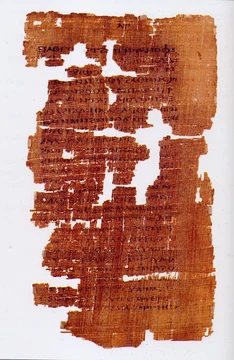
First Epistle of John
A New Testament epistle on love, fellowship, and discerning true teachers.

The First Epistle of John is the first of the Johannine epistles of the New Testament and the fourth of the catholic epistles. The epistle advises Christians on how to discern true teachers by their ethics, their proclamation of Jesus in the flesh, and by their love.
- field
- New Testament epistle
- language
- Koine Greek
- chapters
- 5
- traditional author
- John the Evangelist
- probable location
- Ephesus
Lore & Background
The epistle partakes of the debate over Jesus's nature, particularly the incarnation. It fiercely denounces docetism, the view that Christ's figure on earth was purely illusionary, in favor of the view that Jesus had a real appearance 'in the flesh.' Chapter 2 refers to a group of proto-Gnostics who left the church and deny that the human Jesus was also the spiritual Christ, denouncing them as 'antichrists.' The author wrote so that the joy of his audience would be full, that they would not practice sin, that they would not be deceived by false teachers, and that believers might continue to know they have eternal life.
Reader's Guide
The First Epistle of John holds significance as a key New Testament text addressing early Christian community fractures and doctrinal disputes, particularly over the nature of Jesus. Its emphasis on love, fellowship, and ethical tests for discerning true teachers has influenced Christian theology and pastoral practice. The epistle's style, described as moving in circles with frequent recapitulations, contrasts with Pauline linear style and resembles Hebrew poetic parallelism. Its reception history includes attestation by Polycarp and Papias of Hierapolis. Surviving early manuscripts include Codex Vaticanus, Codex Sinaiticus, and Codex Alexandrinus. The epistle's prologue concerning the Incarnate Word parallels the Gospel of John's prologue but focuses on the word's existence before the incarnation. The Johannine Comma, a Trinitarian gloss added to Latin translations in the 4th century, was interpolated into 1 John 5:7–8 over the course of the Middle Ages. The epistle's authorship remains debated, with no scholarly consensus on whether John the Apostle, John the Evangelist, John of Patmos, or John the Presbyter wrote it; most critical scholars conclude John the Apostle wrote none of these works.
Did You Know?
- The epistle lacks an epistolary opening or conclusion, unlike other biblical epistles.
- The author addresses the audience as 'little children' (teknia) seven times in the letter.
- The Johannine Comma, a Trinitarian gloss, was interpolated into 1 John 5:7–8 during the Middle Ages.
Authorship and the Question of Date
The letter that bears Clement's name never actually mentions him. It is internally anonymous, yet the vast majority of scholars accept the traditional attribution to Clement I, the fourth bishop of Rome. The epistle opens with a formal greeting from "the Church of God which sojourneth in Rome" to its counterpart in Corinth, and its stylistic unity points to a single hand behind the whole work. Pinning down a precise date remains difficult. A minority of scholars, relying on internal clues, place the composition before AD 70, but the consensus clusters around the close of Domitian's reign, roughly AD 96. The opening line's reference to "sudden and repeated misfortunes and hindrances" is widely read as an allusion to the persecutions of that emperor, which would put the letter in the same window as the Book of Revelation. No credible scholar pushes the date past AD 140.
The Corinthian Schism and the Call to Order
The immediate trigger for the letter was a rupture within the Corinthian congregation: a group of members had forcibly removed several presbyters from their positions of authority. What made the situation particularly troubling, in the author's view, was that no moral wrongdoing had been alleged against the deposed leaders. The letter therefore labels the deposition as both high-handed and without legitimate cause. The author's remedy is unambiguous. He urges the Corinthians to repent, to reinstate the presbyters they had cast out, and to submit once again to their superiors. To justify this demand, he appeals to apostolic precedent, explaining that the Apostles themselves had appointed bishops and deacons and had laid down clear instructions for how the ministry was to be carried forward generation after generation. Notably, the author uses the Greek terms episkopos (overseer) and presbyter (elder) as though they denote the same office, a detail that offers a rare glimpse into how early church governance was understood. The letter is also a product of its anxious moment: many believers were struggling with the fact that Jesus had not yet returned, and the author rebukes those whose faith wavered because of the delay.
A Window into Early Christian Scripture
One of the letter's most valuable contributions to New Testament scholarship is the way it reveals which texts were circulating in the late first century. The author explicitly instructs his readers to "take up the epistle of the blessed Paul the Apostle" addressed to the Corinthians, a phrase that implies written Pauline documents were accessible in both Rome and Corinth. Beyond that direct command, the letter alludes to 1 Corinthians, Romans, Galatians, Ephesians, Philippians, Titus, and 1 Timothy, and borrows numerous phrases recognizable from the Epistle to the Hebrews. There are also possible echoes of Acts. Strikingly, no trace of 1 or 2 Thessalonians or the short letter to Philemon appears anywhere in the text, and knowledge of 2 Corinthians, Colossians, and 2 Timothy seems at best indirect. When the author quotes the words of Jesus, he simply asks his audience to "remember" them, without pointing to any particular written gospel. Bruce Metzger has observed that Clement never explicitly labels these New Testament allusions as "Scripture," a detail that speaks to the still-fluid status of the canon in this period. The letter may also contain an early reference to the martyrdoms of Paul and Peter.
From Pulpit Reading to Canonical Debate
The letter's afterlife in the church was remarkable. In Corinth it was read aloud publicly on a regular basis, and by the fourth century that liturgical practice had spread to congregations well beyond the original city. Translators carried the text from its original Greek into Latin, Syriac, and other languages, ensuring its reach across the expanding Christian world. Yet for centuries the work disappeared from view, and it was not until the seventeenth century that scholars began recovering copies and fragments for study. Its canonical status has always been contested. Some early Christians treated it as sacred scripture, and it was included in major manuscript collections such as the Codex Alexandrinus and the Codex Hierosolymitanus. It also appears alongside the Gospel of John in a fragmentary early Greek and Akhmimic Coptic papyrus. Nevertheless, it was never absorbed into the twenty-seven-book New Testament canon that most modern churches share. Today it is classified among the New Testament apocrypha, and it ranks alongside the Didache as one of the earliest such documents still in existence. As part of the Apostolic Fathers collection, it continues to provide indispensable evidence about the structure and theology of the earliest churches.
Frequently Asked Questions
Who wrote First Epistle of John?
The letter has been traditionally ascribed to John the Evangelist, the same figure credited with the Gospel of John. It stands as the first of three brief Johannine letters in the New Testament.
What is First Epistle of John actually about?
At its core, the epistle is a pastoral guide on love, fellowship, and spotting false teachers. It tells believers to test a teacher's claims by checking whether they affirm Jesus came in the flesh and whether their life reflects genuine love.
How many chapters does First Epistle of John contain?
The letter is divided into five short chapters composed in Koine Greek. Despite its brevity, it covers a dense range of theological and ethical topics.
Where was First Epistle of John written?
Early church tradition points to Ephesus in Asia Minor as the likely place of composition. This location aligns with the broader Johannine literary circle traditionally rooted in that region.
Why is First Epistle of John significant in the canon?
As the fourth of the catholic epistles, it offers one of the clearest New Testament statements on how love functions as the practical test of authentic faith. Its warnings against docetic teaching and its call to mutual love have shaped Christian community life for centuries.
More in Christian Scriptures And Epistles 1-18
Spotted an error? Know more?
This is a living reference — every entry is fact-audited, and reader corrections feed straight into our audit queue. Suggest an edit · See this site's audit record