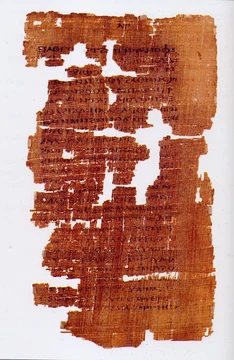
Epistle of James
A New Testament epistle emphasizing faith demonstrated through works.

The Epistle of James is a general epistle and one of the 21 epistles in the New Testament, written originally in Koine Greek. It aims to reach a wide Jewish audience and survives in manuscripts from the 3rd century onward, dated between the mid-1st and mid-2nd century AD. The letter is attributed traditionally to James the brother of Jesus (James the Just), though this authorship is debated, with modern scholars often viewing it as pseudonymous.
- Language
- Koine Greek
- Genre
- Public letter, diaspora epistle, wisdom literature
- Traditional Author
- James the brother of Jesus (James the Just)
- Earliest Manuscripts
- Mid-to-late 3rd century
- Date Range
- Mid-1st to mid-2nd century AD
- Canonical Status
- New Testament, disputed early, recognized by late 4th century
Lore & Background
The Epistle of James is identified in James 1:1 as written by 'James, a servant of God and of the Lord Jesus Christ' to 'the twelve tribes scattered abroad.' Traditionally, this James is understood as James the brother of Jesus, a prominent early church figure. Early church figures like Origen accepted the epistle as Scripture and attributed it to James the brother of the Lord, though he did note that its authorship was disputed by some. Eusebius later categorized it among the 'disputed' books, and Jerome reported that some claimed it was published under James's name by someone else. The epistle was sparsely cited in early Christianity and gained wider recognition only by the late 4th century.
Reader's Guide
The Epistle of James is significant for its emphasis on ethical living and the necessity of works as evidence of faith, teaching that 'faith without works is dead.' It addresses moral concerns such as pride, hypocrisy, favoritism, and slander, advocating for humility, wisdom aligned with spiritual values, and prayer. The letter is modeled on Jewish diaspora epistles and wisdom literature, blending moral exhortation with possible influences from Jesus' sayings and Greco-Roman traditions. Its historical context is debated, with some viewing it as a response to Pauline theology and others as rooted in a Jewish-Christian milieu marked by tensions between rich and poor and emerging divisions between Jews and Christians. The epistle was criticized by Martin Luther during the Reformation for its teachings on faith and works, but it remained part of the New Testament canon. In recent decades, it has attracted increased scholarly interest due to the quest for the historical James and awareness of the Jewish grounding of early Christianity.
Did You Know?
- The Epistle of James is dated between the mid-1st and mid-2nd century AD, with the earliest surviving manuscripts from the mid-to-late 3rd century.
- Martin Luther derided the Epistle of James as an 'epistle of straw' and denied it was the work of an apostle.
- The epistle is modeled on Jewish diaspora letters, similar to those preserved in 2 Maccabees and by Josephus.
- Some scholars argue the epistle is pseudonymous due to its sophisticated Greek and possible dependence on later texts like 1 Peter.
The Question of Who Wrote It
The opening verse names the author simply as "James, a servant of God and of the Lord Jesus Christ," but this identification has generated centuries of debate. James was an extraordinarily common name in the ancient world, and several early Christian figures bore it—including James the son of Zebedee, James the Less, James the son of Alphaeus, and James the brother of Jesus. The traditional attribution links the letter to James the brother of Jesus, sometimes called James the Just, who held the most prominent role in the early Jerusalem church. Yet the earliest surviving references reveal the controversy was already alive: Origen may have been the first to connect the epistle to "James the brother of the Lord," a link preserved only in Rufinus's Latin rendering. Eusebius explicitly noted the attribution was "disputed," and Jerome reported that some believed another hand had published the letter under James's name before it gradually gained authority. Modern scholarship frequently regards the work as pseudonymous, pointing to the letter's accomplished Greek, its possible dependence on texts like 1 Peter, and the absence of any independent evidence that Jesus's brother received a Greek education.
Literary Form & Cultural Setting
The Epistle of James was composed in Koine Greek and survives in manuscripts dating from the third century onward, with scholars placing its composition somewhere between the mid-first and mid-second centuries AD. Rather than following the typical Pauline letter structure, it is classified as a general epistle modeled on Jewish diaspora correspondence and wisdom literature. Its rhetorical texture blends moral exhortation with what appear to be sayings traceable to Jesus, alongside influences from Greco-Roman philosophical and rhetorical traditions. The intended audience is explicitly Jewish: the opening addresses "the twelve tribes scattered abroad," signaling a broad diaspora readership. The historical backdrop remains contested. Some scholars read the letter as a direct response to Pauline theology, while others situate it within a Jewish-Christian community grappling with internal tensions—economic disparity between rich and poor, emerging fault lines between Jewish and Christian identity, and ethical obligations toward marginalized members of the community.
Ethical Vision & The Faith-Works Debate
At the heart of the epistle lies a sustained ethical program. James presses readers toward perseverance through trials, humility in place of pride, and a wisdom rooted in spiritual rather than worldly values. The letter names specific vices—hypocrisy, favoritism, slander—and calls for concrete communal practices such as caring for the poor and anointing the sick. Its most theologically charged teaching insists that genuine faith must be evidenced by works, declaring that faith without works is dead. This stance places the epistle in tension with Pauline theology for many readers, though scholars differ on whether James was actually engaging Paul or addressing a separate set of community concerns. The letter also emphasizes prayer in all circumstances and urges believers to live in accordance with the teachings they have already received, framing ethical conduct not as an add-on to belief but as its necessary expression.
A Contested Place in the Canon
Despite its presence in the New Testament, the Epistle of James occupied an uneasy position in early Christian reception. It was disputed and only sparsely cited in the earliest centuries, and it did not achieve wide recognition until the late fourth century. The Reformation sharpened the controversy: Martin Luther dismissed the letter as an "epistle of straw," objecting to its emphasis on works alongside faith, and denied it was the work of an apostle. Nevertheless, it remained within the canonical collection. In recent decades, however, the epistle has experienced a remarkable scholarly revival. This renewed interest is tied to a broader quest for the historical James—his beliefs, his relationships, and his role in shaping early Christianity—and to a growing awareness of the deeply Jewish grounding of both the letter and the earliest Christian communities. This "James revival" has repositioned the epistle from a marginal, disputed text to a central document for understanding the Jewish roots of the New Testament.
Frequently Asked Questions
Who is the traditional author of the Epistle of James?
The letter has long been credited to James the Just, the brother of Jesus, who was a prominent leader in the early Jerusalem church. However, many modern scholars question that attribution and treat the work as pseudonymous, meaning an unknown writer composed it under James's name.
What is the Epistle of James's central message or 'role' in the New Testament?
It serves as a practical wisdom letter urging believers that genuine faith must be made visible through concrete good deeds, rather than remaining a private conviction. It blends pastoral instruction with proverbial sayings aimed at a broad Jewish diaspora audience.
What genre and language does the Epistle of James belong to?
Written in Koine Greek, it is classified as a general (public) epistle, a diaspora letter, and a piece of wisdom literature. This triple genre identity sets it apart from the more narrative-heavy Gospels or the apocalyptic tone of Revelation.
When was the Epistle of James composed, and how old are the surviving copies?
Scholars generally place its composition somewhere between the mid-first and mid-second century AD. The earliest physical manuscripts that survive date to the mid-to-late third century, so we rely on later copies to reconstruct the original text.
Why is the Epistle of James significant in the canon, and was its inclusion always accepted?
It is one of the twenty-one epistles in the New Testament and carries a distinctive emphasis on works alongside faith that has shaped Christian ethics for centuries. Its canonical status was contested in the early church, but it secured wide recognition by the late fourth century.
More in Christian Scriptures And Epistles 1-18
Spotted an error? Know more?
This is a living reference — every entry is fact-audited, and reader corrections feed straight into our audit queue. Suggest an edit · See this site's audit record