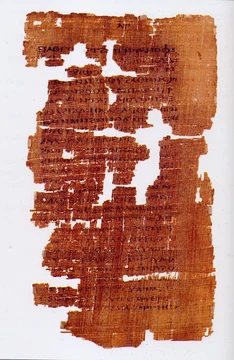
Epistle of Jude
A brief, combative letter urging defense of the faith.

The Epistle of Jude is the penultimate book of the New Testament. It is a brief, combative, and impassioned letter of 25 verses, likely intended as a circular letter to Jewish Christians familiar with the Hebrew Bible and Enochian references. The epistle claims authorship by Jude, identified as a servant of Jesus and brother of James (and possibly Jesus), though there is scholarly debate about his exact identity, literacy, and the letter's date.
- canonical_status
- Widely accepted by most churches by the early second century, though not universally; formal inclusion solidified by the late fourth century
Lore & Background
The Epistle of Jude claims authorship by Jude, identified as a servant of Jesus and brother of James. Little is known about Jude himself. As the brother of James, it has traditionally meant Jude was also a brother of Jesus, since James is described as being the brother of Jesus. However, there is a dispute as to whether 'brother' means someone who has the same father and mother, or a half-brother, cousin, or more distant familial relationship. Debate continues as to whether the author is the apostle, the brother of Jesus, both, or neither. Scholars have argued that since the author has not identified himself as an apostle and refers to the apostles as a third party, he cannot be identified with Jude the Apostle. Other scholars have drawn the opposite conclusion. A reason to doubt that a relative of Jesus wrote the book is that they are unlikely to have been literate; Jesus's family were common laborers from Aramaic-speaking Galilee, and the epistle is written in excellent, complicated Koine Greek.
Reader's Guide
The Epistle of Jude is significant for its vivid condemnation of vague opponents—variously interpreted as rebellious leaders, heretics rejecting divine or ecclesiastical authority, proto-Gnostics, or critics of Pauline teachings—but their exact identity remains uncertain due to the epistle's ambiguous and limited descriptions. It urges believers to defend the faith against false teachers and warns of destructive consequences by recalling examples of divine judgment. The epistle references both canonical books like Zechariah and non-canonical works such as the Book of Enoch and the Assumption of Moses, indicating its author's familiarity with a range of writings. One aspect of the potential ideology discussed is that the opponents denigrate angels and their role; if so, the epistle is possibly a counterpoint to the Epistle to the Colossians, implying the two letters might be part of an early Christian debate on Christian angelology. Many scholars believe the strong similarities between Jude and 2 Peter indicate that one borrowed from the other or both used a common source, with most favoring Jude as the earlier text. The epistle was disputed but gradually accepted as canonical by most churches by the late second century, despite early doubts about its authorship and content due to its rare citation and use of apocryphal sources.
Did You Know?
- The Epistle of Jude quotes the non-canonical Book of Enoch and the Assumption of Moses.
- Many scholars believe Jude was the earlier text compared to 2 Peter, with most favoring Jude as the source.
- The epistle's opponents may have denigrated angels, possibly making it a counterpoint to the Epistle to the Colossians.
- An early Syriac tradition identified the Apostle Thomas as 'Judas Thomas' (the twin), but not as Judas the brother of Jesus or the author of Jude.
The Mystery of the Author
The letter opens with a deceptively simple self-identification: Jude, a servant of Jesus Christ and brother of James. In the ancient world, introductions typically named a father, so pointing to a brother instead signals that this sibling was already well known within the community. Most readers assume James refers to the prominent early church leader, brother of Jesus, making the author a member of Jesus's own household. Clement of Alexandria, writing in the late second century, explicitly called Jude a son of Joseph and a sibling of Jesus. Yet the meaning of "brother" in Semitic and Greek usage stretches far beyond a shared womb; it can encompass cousins or more distant kin. As the doctrine of the Virgin Birth crystallized, Saint Jerome reinterpreted the relationship, arguing that both Mary and Joseph remained virgins their entire lives, which would make James and by extension Jude cousins rather than full siblings. Beyond the epistle, the New Testament mentions a Jude five times: three as the Apostle, two as Jesus's brother. Scholars remain divided on whether the author is the apostle, the sibling, both, or an entirely different person who happened to share the name.
A Rhetorical Arsenal in Twenty-Five Verses
At just twenty-five verses, the Epistle of Jude is a brief, combative, and impassioned letter likely intended as a circular communication to Jewish Christians familiar with Hebrew Bible and Enochian references. Its central aim is to press believers to stand firm against false teachers, invoking the destructive consequences that await them through vivid recollections of divine judgment on the rebellious and the faithless. The author encourages steadfastness in God's love despite scoffers, deploying striking imagery to paint a picture of these adversaries. What makes the letter remarkable is its source material: it draws on both canonical texts such as Zechariah and non-canonical writings including the Book of Enoch and the Assumption of Moses, indicating the author's familiarity with a wide range of literature. The opponents themselves remain deliberately vague—variously interpreted as rebellious leaders, heretics rejecting divine or ecclesiastical authority, proto-Gnostics, or critics of Pauline teachings—but their exact identity stays uncertain due to the epistle's ambiguous and limited descriptions. The letter concludes with a doxology, a formal praise of God that frames the entire argument within a theological context of worship.
The Angelology Crossroads
One of the most theologically significant threads in the epistle involves the opponents' treatment of angels. The letter accuses them of heaping abuse on celestial beings, denigrating angels and their role. If this was indeed a core part of the ideology the author opposed, then the epistle functions as a counterpoint to the Epistle to the Colossians. Colossians condemns those who give angels undue prominence and worship them; this implies the two letters might be part of an early Christian debate on Christian angelology. The phrase "heap abuse on celestial beings" may reflect early Christian tensions between more Jewish-aligned figures like James and Jude and the Pauline tradition, which emphasized believers' authority over angels and rejected strict adherence to Jewish law. This positions the epistle at a crossroads of competing theological currents within the first-century church, where the proper status and function of angelic beings was still being negotiated. The author's insistence on defending the angels' dignity against those who heap abuse on them suggests a community in which angelic hierarchy was a live and contested issue, not a settled doctrine.
A Contested Path to the Canon
The Epistle of Jude's path to canonical status was neither swift nor uncontested. It was disputed in early centuries, with doubts about its authorship and content fueled by its rare citation and its use of apocryphal sources like the Book of Enoch. Gradually, however, most churches accepted it as canonical by the late second century, and its formal inclusion in the New Testament canon was solidified by the late fourth century. A separate scholarly puzzle involves the striking similarities between Jude and 2 Peter, particularly in 2 Peter 2 and Jude 4–18. Most scholars favor the view that Jude is the earlier text and that 2 Peter borrowed from it, though some propose both drew on a common source, and conservative objections to this ordering persist. The letter's most likely composition date is the late first century, with some scholars considering its authorship pseudepigraphical—meaning a later writer composed it under Jude's name. This combination of disputed origins, apocryphal citations, and textual overlap with another epistle makes the Epistle of Jude one of the New Testament's most complex books in terms of its reception history.
Frequently Asked Questions
Who wrote the Epistle of Jude?
The letter is attributed to Jude, who introduces himself as a servant of Jesus and the brother of James. Scholars still debate whether this Jude is the same figure as Jesus' own brother or a different individual, and questions remain about his literacy and the letter's exact date.
What is the Epistle of Jude about?
It is a short, urgent letter that warns its readers about false teachers who have crept into the community and urges them to defend their shared faith. The tone is fierce and apocalyptic, weaving in Old Testament stories and Enochic material to illustrate the consequences of apostasy.
How long is the Epistle of Jude?
At only 25 verses, it ranks among the shortest books in the New Testament. Despite its compact length, it is densely packed with scriptural allusions, vivid imagery, and a passionate rhetorical argument.
When did the Epistle of Jude become part of the Bible?
Most early Christian communities treated it as scripture by the second century, though acceptance was not yet universal in every region. Its formal inclusion in the New Testament canon was solidified by the late fourth century.
Who was the Epistle of Jude addressed to?
It was most likely circulated as a letter to Jewish Christian communities that were well-versed in the Hebrew Bible and familiar with texts such as the Book of Enoch. The author speaks to them as fellow believers facing internal spiritual pressure from those promoting heterodox teaching.
More in Christian Scriptures And Epistles 1-18
Spotted an error? Know more?
This is a living reference — every entry is fact-audited, and reader corrections feed straight into our audit queue. Suggest an edit · See this site's audit record