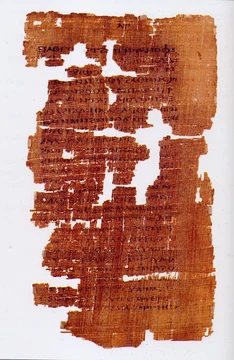
Epistle to the Philippians
A Pauline epistle, likely a composite of letter fragments.

The Epistle to the Philippians is a Pauline epistle of the New Testament of the Christian Bible. It is attributed to Paul the Apostle, with Timothy named as co-author or co-sender, and is addressed to the Christian church in Philippi. The letter is significant as a composite work, likely compiled from multiple letter fragments written by Paul to the Philippian church, reflecting his imprisonment and theological concerns.
- Attributed Author
- Paul the Apostle, with Timothy as co-author
- Recipients
- Christian church in Philippi
- Composition Date
- 50s or early 60s AD
- Likely Place of Writing
- Rome, around 62 AD
- Original Language
- Koine Greek
- Literary Unity
- Disputed; likely a composite of multiple letter fragments
Lore & Background
The Epistle to the Philippians is attributed to Paul the Apostle, with Timothy named as co-author or co-sender. Paul, Timothy, Silas (and perhaps Luke) first visited Philippi in Greece (Macedonia) during Paul's second missionary journey from Antioch, between approximately 50 and 52 AD. In the account in Acts of the Apostles, Paul and Silas are accused of 'disturbing the city'. The letter is addressed to the Christian church in Philippi.
Reader's Guide
There is a general consensus that Philippians consists of authentically Pauline material, but that the epistle is a composite of multiple letter fragments from Paul to the church in Philippi. According to Philip Sellew, these fragments include Letter A (Philippians 4:10–20), a thank-you note; Letter B (Philippians 1:1–3:1, possibly including 4:4–9 and 4:21–23); and Letter C (Philippians 3:2–4:1, possibly including 4:2–3), a testament to Paul's rejection of worldly things. Support for this composite view includes abrupt shifts in tone and topic, and chronological inconsistencies concerning Paul's associate Epaphroditus. The letters could have been written from Ephesus (52–55 AD), Caesarea Maritima (57–59), or most likely Rome (around 62 AD).
Did You Know?
- The epistle is a composite of at least three letter fragments, according to a consensus that emerged in the 1960s.
- Paul and Silas were accused of 'disturbing the city' during their first visit to Philippi.
- The letter was likely written while Paul was in custody, but the specific imprisonment is uncertain.
- The earliest surviving manuscript is Papyrus 16, dating from the 3rd century.
Structure and the Epistolary Convention
Philippians follows the formalized Hellenistic epistolary tradition that shaped all Christian letters of the period. As classicist Steve Reece demonstrated after comparing thousands of Greek, Roman, and Jewish letters contemporary with Paul, the apostle adhered closely to standard epistolary conventions. The letter opens with the author's name placed at the very beginning, immediately followed by the recipient—a format visible in Philippians 1:1. This stands in contrast to modern correspondence, where the sender's identity often appears at the close. After the identification of writer and audience, Pauline letters typically offer the greeting 'Grace and peace to you,' a phrase that merges the Hellenistic greeting of grace with the Jewish greeting of shalom. A word of thanks to the audience may follow, and in the absence of a postal system, a courier might be named. The body of the letter then begins with a brief introductory statement that frames the main topic to be developed in the pages that follow.
Authorship and the Pauline Corpus
Philippians belongs to the group of thirteen New Testament books traditionally attributed to Paul the Apostle, a collection that includes some of the earliest surviving Christian documents. While most scholars agree that Paul personally authored seven of these letters, the broader corpus has generated significant debate. Four letters—Ephesians, First Timothy, Second Timothy, and Titus—are considered pseudepigraphic by many, possibly composed or reconstructed by Paul's followers, and two others (Second Thessalonians and Colossians) are viewed as even less likely to be his work. Philippians, however, sits among the undisputed seven. Even so, scholars note that Paul likely composed his letters with the assistance of a secretary, or amanuensis, who may have shaped the stylistic texture of the text, if not its theological substance. The Epistle to the Hebrews, though once considered Pauline, was questioned by Origen in the third century and is now largely excluded from Paul's authentic writings.
Theological and Historical Weight
As one of the Pauline epistles, Philippians occupies a position of extraordinary weight in the Christian canon. These letters, taken together, serve as foundational texts for both Christian theology and ethics, offering a window into the beliefs, practices, and controversies that shaped the earliest communities of faith. Because they rank among the earliest extant Christian documents, they preserve a snapshot of a religion still in formation, grappling with questions of identity, authority, and doctrine. Philippians thus sits at a crossroads of narrative history and doctrinal instruction, bridging the story of the apostles with the theological reflection that followed.
A Letter Within a Long Literary Tradition
The epistolary form that Philippians inhabits did not originate with early Christianity. The genre of formal, didactic letter-writing stretches back to ancient Egypt, where it formed part of the scribal-school curriculum. Egyptologist Edward Wente speculated that the Fifth-Dynasty pharaoh Djedkare Isesi, in his correspondence with viziers, may have been a pioneer of the genre, and its existence is firmly attested by the Sixth Dynasty. Standardized epistolary formulae were established by the Middle Kingdom, and the 'Satirical Letter' on Papyrus Anastasi I was copied as a writing exercise by schoolchildren on ceramic ostraca—over eighty such examples survive. In the Greek and Roman world, Cicero's letters preserved colloquial Latin, Pliny the Younger crafted self-conscious prose, Ovid composed verse epistles in elegiac couplets, and Seneca's moral letters influenced later patristic writers. Philippians, written in accordance with this formalized Hellenistic tradition, is thus the latest link in a chain of letter-writing that spans millennia.
Frequently Asked Questions
Who wrote the Epistle to the Philippians?
The letter is attributed to Paul the Apostle, with Timothy named as a co-sender. It was composed in Koine Greek, most likely in the 50s or early 60s AD.
Who is the Epistle to the Philippians addressed to?
It was sent to the Christian community in Philippi, a Roman colony in Macedonia. Paul writes to them from a period of imprisonment, with Rome around 62 AD being the most commonly proposed location.
Is the Epistle to the Philippians a single unified letter?
Its literary unity is disputed among scholars, who generally regard it as a composite assembled from several shorter letter fragments Paul sent to the Philippian church. The text we read today likely stitches together multiple pieces of correspondence into one document.
What role does the Epistle to the Philippians play in the New Testament?
It is classified as a Pauline epistle and functions as a pastoral, personal communication from an imprisoned apostle to a local congregation. It tackles themes such as joy amid suffering, humility, and the life of a Christian community.
Why is the Epistle to the Philippians important to readers and scholars?
It provides one of the most intimate windows into Paul's personal voice, especially his reflections on imprisonment and contentment. Its composite structure also makes it a key text for understanding how early Christian letters were collected, edited, and preserved.
More in Christian Scriptures And Epistles 1-18
Spotted an error? Know more?
This is a living reference — every entry is fact-audited, and reader corrections feed straight into our audit queue. Suggest an edit · See this site's audit record