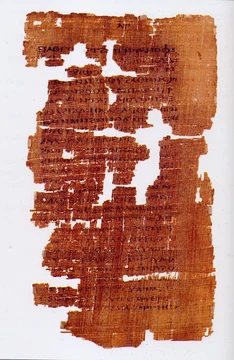
Epistle to the Hebrews
An anonymous New Testament epistle urging perseverance amid persecution.

The Epistle to the Hebrews is one of the books of the New Testament. Its text does not mention the name of its author, but it was traditionally attributed to Paul the Apostle; most ancient Greek manuscripts, the Old Syriac Peshitta, and some Old Latin manuscripts place it among Paul's letters. Modern biblical scholarship considers its authorship unknown, with Pauline authorship mostly rejected.
- field
- New Testament epistle
- language
- Koine Greek
- traditional_author
- Paul the Apostle (disputed)
- modern_view
- Authorship unknown
- theme
- The person of Jesus Christ as mediator between God and humanity
- audience
- Likely Jewish Christians, possibly in Jerusalem
Lore & Background
The Epistle to the Hebrews does not name its author. By the end of the first century there was no consensus on the author's identity. Over the centuries, scholars have suggested Clement of Rome, Barnabas, Paul the Apostle, Luke the Evangelist, Silas, Apollos, and Priscilla and Aquila as possible authors. In the 3rd century, Origen wrote that the diction and style differ from Paul's, but the matter is wonderful and equal to Paul's acknowledged writings; he concluded that who wrote the epistle is known to God alone. In the 4th century, Jerome and Augustine supported Paul's authorship, and the Church largely agreed to include Hebrews as the fourteenth letter of Paul until the Reformation. Many scholars now believe the author was one of Paul's pupils or associates, citing stylistic differences. Some contend it was authored by Apollos or Priscilla and Aquila. A.J. Gordon and Adolf von Harnack proposed Priscilla as author, arguing the name was deliberately suppressed.
Reader's Guide
The Epistle to the Hebrews is significant for its polished and eloquent Greek, considered more carefully composed than any other New Testament book. Its essential purpose was to exhort Christians to persevere in the face of persecution, with some believers considering turning back to Judaism to escape persecution for believing Jesus to be the Messiah. The theme is the teaching of the person of Jesus Christ and his role as mediator between God and humanity. The epistle presents Jesus with the titles 'pioneer' or 'forerunner', 'Son' and 'Son of God', 'priest' and 'high priest', casting him as both exalted Son and High Priest in a unique dual Christology. It opens with an exaltation of Jesus as 'the radiance of God's glory, the express image of his being, and upholding all things by his powerful word'. The work uses Old Testament quotations interpreted in light of first-century rabbinical Judaism. Because of its anonymity, it had trouble being accepted as part of the Christian canon, classed with the Antilegomena, but was eventually accepted because of its sound theology and eloquent presentation.
Did You Know?
- Scholars of Greek consider Hebrews to be more polished and eloquent than any other book of the New Testament.
- The text does not mention the name of its author, and modern scholarship mostly rejects Pauline authorship.
- Some scholars believe it was written for Jewish Christians who lived in Jerusalem.
- The epistle presents Jesus with the unique dual Christology of both exalted Son and High Priest.
The Anonymous Author and the Question of Paul
The letter never names its writer, and by the close of the first century no agreement existed on who composed it. Over the centuries, a long list of candidates has surfaced—Clement of Rome, Barnabas, Luke, Silas, Apollos, and the couple Priscilla and Aquila—yet modern biblical scholarship largely treats the author as unknown and rejects Pauline authorship. The traditional attribution to Paul rests on the fact that most Ancient Greek manuscripts, the Old Syriac Peshitta, and some Old Latin witnesses file the epistle among Paul's letters, and that chapter thirteen mentions Timothy as a companion while the writer says he is in Italy. Still, Origen in the third century observed that the diction lacks Paul's characteristic roughness and that the sentence construction follows Greek usage more closely, suggesting someone who remembered Paul's teaching and rendered it in his own phrasing. Jerome and Augustine in the fourth century still championed Paul's hand, and the Church held that view until the Reformation. Today, many scholars see the writer as a leader of a predominantly Jewish congregation, possibly a pupil or associate of Paul.
A Polished Greek and a Dual Christology
Greek scholars rank the epistle's prose as the most polished and eloquent in the entire New Testament, noting that its carefully composed and studied language stands in sharp contrast to Paul's spontaneous, volatile, context-driven Greek. The text is described as intricate, and its Christology is distinctive: it casts Jesus simultaneously as exalted Son and as High Priest, a dual portrait that has no parallel elsewhere in the New Testament. The opening verses declare him the radiance of God's glory, the express image of his being, and the one who upholds all things by his powerful word. Throughout the letter he is called pioneer or forerunner, Son, Son of God, priest, and high priest. This priestly dimension draws on Old Testament quotations interpreted through first-century rabbinical Judaism, and scholar Eric Mason has shown that the conceptual background closely parallels the messianic priest and Melchizedek figures in the Qumran scrolls, where a priestly figure is discussed alongside a Davidic figure, appointed by divine decree to offer an eschatological sacrifice of atonement.
A Letter to Persecuted Jewish Believers
The essential purpose of the epistle was to exhort its readers to persevere under persecution. At the time of writing, certain believers were contemplating a return to Judaism and the Jewish system of law as a way to escape the suffering that came from confessing Jesus as the messiah. Traditional scholarship framed the argument as a continuation of Paul's supersessionist logic: the Jewish Law had served a legitimate role in the past but was now replaced by a New Covenant for the Gentiles. However, a growing number of scholars point out that the terms Gentile, Christian, and Christianity never appear in the text, and they propose that Hebrews was addressed to a Jewish audience. In this reading, the letter functions less as a Pauline argument about Gentile inclusion and more as a debate between Jewish followers of Jesus and proto-rabbinical Judaism. In tone and detail, the epistle goes beyond Paul, offering a more complex, nuanced, and openly adversarial definition of that relationship.
Canon, Controversy, and Lasting Influence
Because it bore no author's name, the epistle encountered resistance on its way into the Christian canon and was classed among the Antilegomena, the disputed books. Its eventual acceptance as Scripture rested on its sound theology, its eloquent presentation, and other intrinsic qualities that convinced the broader Church of its value. In antiquity, certain circles began ascribing it to Paul, and by the fourth century Jerome and Augustine had firmly supported that attribution, leading the Church to count it as the fourteenth Pauline letter—a position maintained until the Reformation. The letter's theological vocabulary, particularly its priestly Christology, left a lasting mark on how Christians conceive of Jesus's mediatorial role between God and humanity. The Qumran parallels identified by scholars such as Eric Mason further demonstrate that the epistle drew on a rich Second Temple Jewish background, giving it a depth that continues to shape academic and devotional engagement with the text.
Frequently Asked Questions
Who wrote the Epistle to the Hebrews?
The letter is anonymous; no author's name appears anywhere in the text. Although it was long attributed to Paul the Apostle and grouped among his letters in many early Greek and Syriac manuscripts, most modern scholars regard the true authorship as unknown.
What is the central message of the Epistle to the Hebrews?
The letter presents Jesus Christ as the supreme mediator between God and humanity, arguing that his single sacrificial death fulfills and permanently surpasses the old Levitical priesthood and temple system.
Who was the Epistle to the Hebrews addressed to?
It was most likely written to Jewish Christians facing persecution and tempted to drift back toward Judaism. The audience appears to have been a community in or near Jerusalem that already understood the faith well but needed encouragement to hold firm under pressure.
Why is the Epistle to the Hebrews significant in Christian theology?
It offers one of the most detailed New Testament treatments of Christ's priestly role, drawing on the Melchizedek tradition to show that Jesus' sacrifice replaces the repeated animal offerings of the Mosaic law. The letter also became a key text for understanding how the old covenant relates to the new.
What does the Epistle to the Hebrews say about perseverance in faith?
The letter repeatedly urges its readers to remain steadfast in their commitment to Christ despite suffering and social pressure. It frames faithfulness as a race to be run and warns against the danger of drifting away from the truth under sustained hardship.
More in Christian Scriptures And Epistles 1-18
Spotted an error? Know more?
This is a living reference — every entry is fact-audited, and reader corrections feed straight into our audit queue. Suggest an edit · See this site's audit record