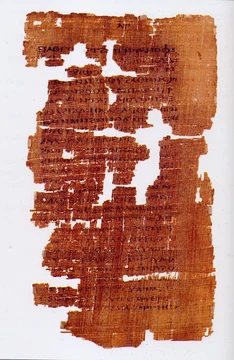
Epistle to the Galatians
Paul's letter arguing Gentiles need not follow Mosaic Law.

The Epistle to the Galatians is the ninth book of the New Testament and the fourth of the Pauline epistles in traditional arrangement. It is a letter from Paul the Apostle to a number of Early Christian communities in Galatia, a region in Anatolia. The letter was originally written in Koine Greek and later translated into other languages. Scholars debate whether Galatia refers to the Roman province in southern Anatolia or a larger region defined by the Galatians, an ethnic group of Celtic people in central Anatolia.
- field
- Christian theology, New Testament studies
- known_for
- Arguing that Gentile Christians do not need to adhere to the Mosaic Law, particularly circumcision
- language
- Koine Greek
- earliest_manuscript
- Papyrus 46 (~AD 200)
Lore & Background
The Epistle to the Galatians is a letter from Paul the Apostle to early Christian communities in Galatia. The central dispute concerns how Gentiles could convert to Christianity, indicating the letter was written at a very early stage in church history, when most Christians were Jewish or Jewish proselytes. Paul argues that the Gentile Galatians do not need to adhere to the Mosaic Law, particularly religious male circumcision, by contextualizing the role of the law in light of the revelation of Christ. The letter shows no hint of a developed organization within the Christian community, placing it during Paul's lifetime.
Reader's Guide
The Epistle to the Galatians has exerted enormous influence on the history of Christianity, the development of Christian theology, and the study of the Apostle Paul. Biblical scholars agree that Galatians is a true example of Paul's writing, with its authenticity unquestioned in scholarship. The letter is principally concerned with the controversy surrounding Gentile Christians and the Mosaic Law during the Apostolic Age. Paul's argument that Gentiles do not need to adhere to the Mosaic Law, particularly circumcision, shaped early Christian identity and the relationship between Jewish and Gentile believers. The letter's dating is debated: a majority of scholars agree it was written between the late 40s and early 50s, with some dating it to c. 50–60. The absence of any mention of the Council of Jerusalem's decision strongly implies Galatians was written prior to that council, which took place in 48–49 AD. The letter's audience and the identity of Paul's opponents are also matters of scholarly dispute, with most modern scholars viewing them as Jewish Christians who taught that converts must follow some or all of the Jewish Law.
Did You Know?
- Scholars debate whether Galatia refers to the Roman province in southern Anatolia or a region defined by the Celtic Galatians in central Anatolia.
- The letter shows no hint of a developed organization within the Christian community, indicating it was written during Paul's lifetime.
- The absence of any mention of the Council of Jerusalem's decision strongly implies Galatians was written prior to that council.
The Hellenistic Framework of Pauline Correspondence
The Pauline epistles, including Galatians, were composed within a formalized Hellenistic letter-writing tradition that stretched across centuries and cultures. Classicist Steve Reece has examined thousands of Greek, Roman, and Jewish letters from Paul's era and found that Paul adhered to many standard epistolary conventions of his time. This means Galatians is not an isolated document but part of a broader literary culture whose roots reach back to ancient Egypt, where epistolary formulae were already codified by the Middle Kingdom. The structure Paul followed included naming the author first, then the recipient, followed by a greeting. In Galatians, as in other Pauline letters, this would have been followed by the characteristic 'Grace and peace to you' salutation—a blend of the Hellenistic greeting of 'grace' and the Jewish greeting of 'shalom.' This dual formula reflected Paul's own position straddling two cultural worlds. A word of thanks to the audience might also appear, and in secular letters of the period, a prayer for health typically followed the opening.
Authorship, the Amanuensis, and the Authenticity Debate
The thirteen books attributed to Paul the Apostle form the Pauline epistles, among the earliest surviving Christian documents. Most scholars agree Paul personally authored seven of these letters, while four—Ephesians, First Timothy, Second Timothy, and Titus—are widely considered pseudepigraphic, possibly composed or reconstructed by his followers. Two others, Second Thessalonians and Colossians, are viewed as even less likely to be his work. Galatians falls among the seven undisputed letters. However, even for the authentic ones, scholars note that Paul likely wrote with the assistance of a secretary, or amanuensis, who may have shaped the style if not the theological substance. The scribe who physically transcribed the letter could be named at the letter's closing, as seen in Romans 16:22. This collaborative process means that even Paul's most personal theological arguments were filtered through another hand, adding a layer of complexity to how we read these foundational texts.
Galatians as a Foundational Text for Christian Theology and Ethics
The Pauline epistles, including Galatians, occupy a foundational position in Christian thought. As part of the New Testament canon, they serve as cornerstone texts for both Christian theology and ethics, offering a window into the beliefs and controversies that shaped the earliest Christian communities. These letters are among the oldest extant Christian documents, making them invaluable for understanding how faith was articulated in its formative decades. In modern editions, the Pauline epistles are typically positioned between the Acts of the Apostles and the Catholic (general) epistles. The body of each epistle, including Galatians, traditionally opens with a concise statement introducing the central topic that will unfold through the remainder of the letter.
The Broader Epistolary Heritage from Egypt to the New Testament
The letter form that Paul employed in Galatians descends from a long literary tradition. In ancient Egypt, epistles were a staple of scribal-school curricula, and Egyptologist Edward Wente has suggested that the Fifth-dynasty Pharaoh Djedkare Isesi may have been a pioneer of the genre through his correspondence with viziers. By the Middle Kingdom, standardized formulae for epistolary composition were well established. The Ramesside Period drew on formulae rooted in the Amarna Period of the Twentieth Dynasty. In the Greco-Roman world, the epistle became a major literary genre in both prose and verse. Cicero's letters preserve colloquial Latin and illuminate the late Roman Republic, while Pliny the Younger's correspondence is studied for its self-conscious literary qualities. Seneca's philosophical epistles influenced later patristic writers. Ovid composed three collections of verse epistles in elegiac couplets. This rich heritage of letter-writing provided the structural and cultural vocabulary within which Paul shaped his theological arguments for the Galatian churches.
Frequently Asked Questions
Who wrote the Epistle to the Galatians and to whom was it addressed?
The letter was penned by the Apostle Paul and sent to several early Christian congregations in the region of Galatia, located in what is now central Turkey. It holds the ninth position in the New Testament and the fourth slot in the traditional Pauline epistle collection.
What is the main argument of the Epistle to the Galatians?
Paul's central claim is that Gentile believers are made right with God through faith in Christ alone and carry no obligation to observe the Mosaic Law, especially the requirement of circumcision. He frames this as a defense of the gospel he preaches against rivals who insisted on adding Jewish ritual observance to Christian life.
How does the Epistle to the Galatians end?
The letter closes with Paul's personal exhortation to walk by the Spirit, a sharp warning against those who stir up trouble, and his benediction invoking the grace of Christ upon the readers. He also adds a brief postscript noting that he is composing the final words by his own hand.
Why is Galatians considered important in Christian theology?
It is one of the earliest surviving Christian documents and is widely regarded as a foundational text for the doctrine of justification by faith apart from works of the Law. Reformers such as Martin Luther called it his personal 'epistle to me' because it shaped his understanding of grace and the gospel.
Where exactly is Galatia, and when was the letter originally written?
Scholars still debate whether Paul meant the Roman province in southern Anatolia or the broader territory inhabited by the Celtic Galatian tribes in central Anatolia. The earliest surviving fragment, Papyrus 46, dates to roughly AD 200, though most scholars place the original composition in the mid-first century.
More in Christian Scriptures And Epistles 1-18
Spotted an error? Know more?
This is a living reference — every entry is fact-audited, and reader corrections feed straight into our audit queue. Suggest an edit · See this site's audit record