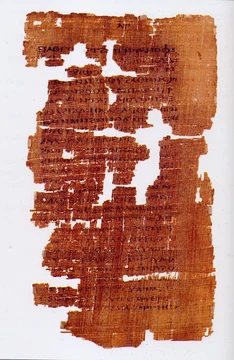
First Epistle to Timothy
A New Testament letter of counsel to Timothy in Ephesus.

The First Epistle to Timothy is one of three letters in the New Testament of the Bible often grouped together as the pastoral epistles, along with Second Timothy and Titus. The letter, traditionally attributed to the Apostle Paul, consists mainly of counsels to his younger colleague and delegate Timothy regarding his ministry in Ephesus. These counsels include instructions on the organization of the Church and the responsibilities resting on certain groups of leaders therein as well as exhortations to faithfulness in maintaining the truth amid surrounding errors. Most modern scholars consider the pastoral epistles to have been written after Paul's death, although a small and declining number of scholars still argue for Pauline authorship.
- Traditional author
- Apostle Paul
- Recipient
- Timothy
- Location addressed
- Ephesus
- Genre
- Pastoral epistle
- Canonical status
- New Testament
Lore & Background
The authorship of First Timothy was traditionally attributed to the Apostle Paul, although in pre-Nicene Christianity this attribution was open to dispute. He is named as the author of the letter in the text. Nineteenth- and twentieth-century scholarship questioned the authenticity of the letter, with many scholars suggesting that First Timothy, along with Second Timothy and Titus, are not the work of Paul, but of an unidentified Christian writing some time in the late-first to mid-second centuries. Most scholars now affirm this view. Modern scholars who support Pauline authorship stress the importance of Polycarp, where there is a high probability that 1 and 2 Timothy were known to him. Scholars Robert Grant, Ian Howard Marshall, and Hans von Campenhausen believe that Polycarp was the actual author of First Timothy, which would date its composition to around 140.
Reader's Guide
The First Epistle to Timothy holds significance as a key text for understanding early Christian church organization and leadership roles. Its counsels include instructions on the organization of the Church and the responsibilities resting on certain groups of leaders, as well as exhortations to faithfulness in maintaining the truth amid surrounding errors. The letter details roles of men and women, particularly in 1 Timothy 2:12, which has been a source of considerable controversy concerning gender equality. Certain Christian churches such as the Eastern Orthodox Church and Roman Catholic Church use it as a justification to reject the ordination of women. The epistle also discusses a list of widows to be supported by the church, setting restrictions on the types of women to help. Its legacy is marked by ongoing scholarly debate over authorship, with most modern scholars considering it written after Paul's death. The letter's influence extends to music, with composers using lines from the epistle in Christmas cantatas, and to figures such as Jonathan Edwards, who identified reading 1 Timothy 1:17 as an important moment in his religious experience.
Did You Know?
- The epistle contains the Greek word ἀρσενοκοίτης, sometimes translated as 'homosexual men,' though its meaning is debated.
- Marcion, an orthodox bishop later excommunicated for heresy, formed an early canon of scripture around 140 that excluded 1–2 Timothy and Titus.
- Jonathan Edwards identified reading 1 Timothy 1:17 as an important moment in his religious experience.
Frequently Asked Questions
Who wrote First Epistle to Timothy and to whom was it addressed?
The letter is traditionally attributed to the Apostle Paul, who writes to his younger colleague Timothy. It belongs to the group of three pastoral epistles in the New Testament, alongside Second Timothy and Titus.
What is First Epistle to Timothy actually about?
The epistle is essentially a practical handbook for Timothy's oversight of the church in Ephesus, covering leadership qualifications, worship conduct, and warnings against false teaching. Paul urges his delegate to stay firm in the truth while errors circulate around him.
Where was Timothy when he received First Epistle to Timothy?
Timothy was based in Ephesus, a major port city in the Roman province of Asia, where he was responsible for guiding the local congregation. Paul composed the letter from elsewhere, offering counsel at a distance.
What makes First Epistle to Timothy a 'pastoral' epistle rather than a doctrinal treatise?
Its content centers on the day-to-day administration of a local church—qualifying elders, ordering deacons, and handling internal disputes—rather than on systematic theological argument. That practical, shepherding tone is what sets it apart from Paul's more argumentative letters like Romans or Corinthians.
Why does First Epistle to Timothy still matter to readers today?
It offers one of the earliest surviving blueprints for how a Christian community should be organized, led, and kept doctrinally sound. Its guidance on character-based leadership and guarding against heresy has continued to influence church governance well into the modern era.
More in Christian Scriptures And Epistles 1-18
Spotted an error? Know more?
This is a living reference — every entry is fact-audited, and reader corrections feed straight into our audit queue. Suggest an edit · See this site's audit record