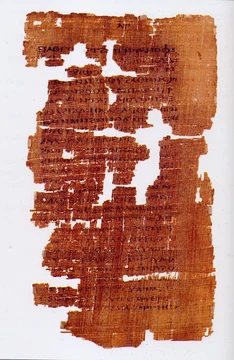
First Epistle to the Corinthians
A Pauline letter addressing issues in the Corinthian church.

The First Epistle to the Corinthians (Ancient Greek: Αʹ Ἐπιστολὴ πρὸς Κορινθίους) is one of the Pauline epistles, part of the New Testament of the Christian Bible. It is addressed to the Christian church in Corinth and addresses various issues which had arisen in that community. The letter is composed in a form of Koine Greek.
- field
- New Testament epistle
- language
- Koine Greek
- author
- Paul the Apostle (with Sosthenes as amanuensis)
- addressee
- Christian church in Corinth
- canonical status
- Included in every ancient canon
Lore & Background
There is a consensus among historians and theologians that Paul is the author of the First Epistle to the Corinthians, except that 1 Corinthians 14:34–35 is 'widely believed' to be a later addition, and the authorship of 1 Corinthians 10:1–22 is challenged by some scholars. The precise role of Sosthenes, mentioned at the beginning of the letter, is uncertain; scholars believe he was the amanuensis who wrote down the text at Paul's direction. The letter later refers to Paul in the first person singular, and the closing includes the line 'I, Paul, write this greeting in my own hand'.
Reader's Guide
The First Epistle to the Corinthians is significant as a canonical Pauline letter that provides insight into early Christian community life and theological disputes. Despite its title, it is not believed to be the first such letter written to the Corinthian church; it is the second known letter of four from Paul to that church, as evidenced by Paul's mention of his previous letter in 1 Corinthians 5:9. The letter is quoted or mentioned by the earliest sources and is included in every ancient canon, including that of Marcion of Sinope. Some scholars point to the epistle's potentially embarrassing references to sexual immorality in the church as strengthening the case for its authenticity. The most discussed textual integrity question concerns 1 Corinthians 14:34–35, which many commentators treat as a post-Pauline interpolation. The letter's unity is defended by most commentators, though some scholars have proposed that it combines material from more than one letter.
Did You Know?
- The letter is not believed to be the first written by Paul to the church in Corinth, only the first canonical letter.
- The majority of early manuscripts end chapter 6 without the phrase 'and in your spirit, which are God's'.
- A group of Western manuscripts places 1 Corinthians 14:34–35 after verse 40 instead of in its usual position.
Frequently Asked Questions
Who is the author of First Epistle to the Corinthians?
The letter is attributed to Paul the Apostle, with Sosthenes serving as his amanuensis (scribe). It is classified among the Pauline epistles in the New Testament.
What is First Epistle to the Corinthians about?
The epistle tackles a range of practical and theological problems that had developed within the Corinthian Christian community, including factional divisions, moral disputes, questions about marriage, and misunderstandings regarding spiritual gifts. Paul writes to correct misconceptions and restore unity in the congregation.
Who is the addressee of First Epistle to the Corinthians?
The letter is directed to the Christian congregation gathered in the city of Corinth, a major port in ancient Greece. Paul addresses them as the community of God located in Corinth, calling them to holiness.
Why is First Epistle to the Corinthians considered important in Christian scripture?
It is included in every ancient biblical canon, making it universally recognized across all major Christian traditions. The letter is especially valued for its extensive discussion of love in Chapter 13, its resurrection theology, and its guidance on the proper use of spiritual gifts.
What language was First Epistle to the Corinthians originally written in?
The epistle was composed in Koine Greek, the common vernacular of the eastern Mediterranean during the first century. This made the letter accessible to the diverse, multilingual congregation in the bustling port city of Corinth.
More in Christian Scriptures And Epistles 1-18
Spotted an error? Know more?
This is a living reference — every entry is fact-audited, and reader corrections feed straight into our audit queue. Suggest an edit · See this site's audit record